

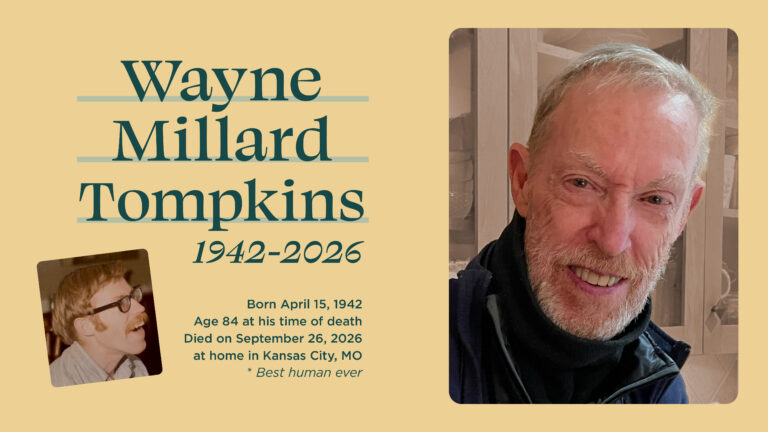
Wayne Millard Tompkins
Share
Let the family know you care by sharing this tribute
The Life of Wayne Millard Tompkins as Remembered by his Son
Wayne Millard Tompkins was an unconventional father, so as a parting gift to the most wonderful dad I could ever have wished for, I, Benjamin Bronson Tompkins, am giving him an unconventional obituary. (It’s lengthy!)
Wayne Millard Tompkins was born on April 15, 1942 in Denver, Colorado, USA to Lloyd Herven Tompkins and Jean Millard Tompkins. He grew up in Lakewood, Colorado, a suburb of Denver, with his two brothers Gary and Jay.
After graduating from high school, he moved to Ft. Collins, Colorado to study music at Colorado State University. Music was a natural choice of major for a self-described “Band Dork.”
Music continued to guide his life after he graduated. He joined a band called the Neversummer Singers*1. While he played with them, he took classes as William Jewel College in Liberty, Missouri. After classes, he’d sit on the stairs on the square in Liberty. My grandfather Joe Wally reportedly saw Wayne playing there one day. Rumor has it that a Republican-esque sticker on Wayne’s guitar case had impressed Joe, who asked Wayne to teach guitar to Joe’s daughter Gail at home. (Little did Joe know that Wayne was a progressive in conservative clothing.) At a lesson, Wayne met Diane Eleanore Wally, one of Joe’s other daughters. They quickly fell in love and got married soon after on August 6, 1965 at First Presbyterian Church in Liberty, Missouri*2.
Wayne served shortly as a hospital orderly*3 and then worked as a substitute music teacher while he tried to get a printshop business off the ground.
The Vietnam War was raging then, and Wayne decided to enlist. (He told me he had wanted to be in the Army band.) He was rejected because of the bad varicose veins he had on his legs.
Wayne and Diane lived as newlyweds on Clark Street in Kansas City, Kansas. They spent their evenings sitting on a small unupholstered loveseat reading JRR Tolkien’s The Hobbit to each other. They then moved across the state line into an apartment above Mario’s Restaurant next door to Westport Post Office in Kansas City, Missouri.
Soon after their move, they had their first son Benjamin Bronson Tompkins (that’s me) in April 1970.
I must have taken up too much space in their apartment, because we moved to a two-story house at 4234 Wyoming St. in Kansas City, Missouri when I was two years old. The house cost $12,000.
My sister Madeline Eleanore Tompkins, their second and last child, was born in February 1973.
Wayne and Diane’s preferences and beliefs began filling the house and my brain. There was espresso, homemade bagels, gardening, art and crafts, reading, and music but no television (until around 1975). We got around by walking or in our red and white Volkswagen bus. We had pets: Boris the beagle, Strider the Labrador mix, Georgia the duck (who was eaten by Strider), and a parrot named Chloe (who flew away).
Wayne and Diane frequently took us on mini-adventures (which he called “WLSTs,” or weird little short trips). The point was to explore and find new things and places, no matter how long it took.
Wayne and Diane kept reading to us and growing our vocabularies. Wayne told me that antidisestablishmentarianism was the longest word in the English language. They regularly spoke to us in “big” words. It took me a while to understand what a “hypothetical situation” was. Palindromes and Spoonerisms were also fascinating.
Once these big words were in our heads, they could begin telling us about civil rights, equality, humility, charity, volunteerism, science, the Metric system, conservation, fine art, architecture, progressive movements, and many other concepts that my “friends” loved to ridicule me about. I grew up convinced that we were a different family with different beliefs.
They sent us to public school, which my friends also loved to ridicule me about. Going to school at Swinney and Volker Elementary Schools and then Lincoln Jr. High School and Lincoln College Prep, I grew up thinking that diversity was normal.
Wayne began working as a ranger at Missouri Town Living History Museum around 1975. He sometimes took me and my sister along and would tell us the names of all the trees there: catalpa, mulberry, oak, persimmon, walnut, locust, sumac… I think it was there where my love for the outdoors and nature began.
He then worked as a forklift operator at Robinson’s, a lawn supply company*4.
In 1982, Wayne decided to go back to school to learn computer programming. He continued forklifting during the day as he studied what is now called coding at nearby Penn Valley Community College at night. My mother used her freshly minted driver’s license to pick him up after class. My sister and I often tagged along. I remember him coming out of the building in the dark of night holding a three-inch-thick stack of punch cards and telling us that they contained the program he had been working on.
He was soon a capable programmer and began working as a system engineer at Stuart Hall stationery.
Then it happened! I was probably 14 years old and over at a friend’s house when my mother called. “There’s something wrong with your father’s heart,” she told me in a worried voice. I rode my bike home only to learn that “something wrong” meant “heart attack,” and he was only 42 years old! Wayne quickly got to the ER for treatment. He was discharged soon thereafter. On returning home, he vowed to eat better and exercise more.
Soon we were eating out much less and having much more pasta, mujadara, salads, and low-fat chicken and vegetable dishes. Wayne repaired an old road bicycle that had been sitting in the basement and started riding it. Soon he was riding centuries (i.e., 100-mile rides).
A much healthier Wayne switched jobs several times and eventually became a programmer at H&R Block. H&R Block was only 2 miles from our home at 38th and Harrison, and he walked to and from work almost every day.
Wayne became a grandfather in April 2000 when my wife Yumiko Tamura gave birth to our first child, Thomas Haru Tompkins, at St. Luke’s Hospital in Kansas City (which is where my sister and I were born). I thought it was really cool to have a Y2K baby, and Wayne thought it equally cool to have a Y2K grandson. His second grandchild, Max Sora Tompkins, was born in September 2003 and then Louisa Yume Tompkins came along in September 2006.
Wayne retired from H&R Block in palindromic 2002 (I think). Some people describe retirement as agonizing, but Wayne always seemed content. Cooking, reading, cycling, grandkids, and learning new things were all he needed to stay entertained, active, and sharp.
In 2009, Yumiko and I (along with his grandkids) moved to Fukuoka, Japan (my wife’s hometown). Wayne and Diane (and Madeline) visited us frequently. Some of their favorite places were:
• Beppu, the city of sulfur, pools of boiling water, and steam. Beppu has the second highest concentration of hot springs in the world (after Yellowstone National Park).
• Mt. Aso, a supervolcano with the world’s largest caldera and a crater that reminds me of Mt. Doom in Lord of the Rings.
• Dazaifu, a suburb of Fukuoka with a massive Shinto shrine over a millennium old and Japan’s first Zen temple.
But Wayne was just as happy wandering around our neighborhood and Fukuoka. He loved maps and would pick out places to go on WLSTs, all by himself. He never got seriously lost despite Fukuoka’s labyrinthine streets and lack of English signs.
We visited Wayne and Diane in Kansas City once a year. Every time, he seemed no older than 50. He even shrugged off a bout of COVID in 2022 that waylaid me for a week.
Wayne remained healthy in body, mind, and spirit into his 80s. Crosswords, reading, and long walks came easy, or even naturally, to him. When I traveled to Denver, Colorado in October 2025 for his brother Jay’s memorial service, Wayne was a bit less mobile but still managed a mile hike at altitude and was as mentally sharp as a 50-year-old.
So I was surprised when my sister Madeline called in May 2026 to tell me to get back to Kansas City ASAP. My arrival coincided with Wayne’s discharge after a two-week hospital stay to evaluate and treat low hemoglobin levels that prevented his body from getting enough oxygen to his organs and tissues.
I stayed with him and my sister Madeline for a month at her house on Oak St. Wayne was still the kind, thoughtful person he had always been. We talked over meals, watched soccer games, and did crossword puzzles. But he needed a walker to get around the house and was unable to navigate stairs without the help of two adults. My mother had often referred to him as a dalmatian because of his incessant need to be outdoors and exploring. Since I’m like that, too, I was sad to see this adventure-lover stuck indoors but equally impressed that he did not let his immobility frustrate him.
Healthcare activities filled the month I was with him. He did at-home rehabilitation three times a week. I saw improvements but also setbacks as he struggled to stand upright and walk under the guidance of his therapists. He napped several times a day, sleeping especially hard after his rehab sessions. His once-thick thighs and calves were rail thin. The visiting nurses collected blood samples to check his hemoglobin concentrations, which always hovered near a level that required transfusion. (He had several of those.) Then there was the twice-a-day ordeal of him taking his meds. It was my first time seeing polypharmacy up close.
One day, he made quesadillas for lunch. Supported by his walker, Wayne cut the ingredients and fried them in a frying pan. Although I didn’t know it at the time, this would be the last meal Wayne—the man who had made many of the meals that nourished the young me, who had cooked for crowds of up to 30 at the many pizza parties he liked to throw, and who had inspired his grandson Max to become a chef—would ever make.
I cherished my month with him and vowed to return in October. In late August, my sister called to tell me that October might be too late. I cleared my schedule and bought plane tickets. Little did I know that he had already decided to start hospice*5.
Thomas (my son and Wayne’s first ever grandson) and I flew over with suitcases loaded with all the Japanese snacks Wayne loved to eat. We brought a few of those snacks when we visited him in the hospice facility the next morning. He was bedridden but cheerful. I was impressed by how relaxed the atmosphere was and how kind the nurses and doctors were. The constant monitoring, medication, and rehab I had witnessed during my previous visit were absent. Thomas, Madeline, and I went back to Madeline’s house that evening, grateful that he was in such good care and that we had been able to spend a great day with him.
A “Turn off the oven now” message from Wayne greeted me on my phone when I woke early the next morning. I thought he was joking, but when we visited him later in the morning, confusion and anxiety had replaced the calmness and lucidity we had seen the day before. In his mind, he was at home, and the oven was on and needed to be turned off! The doctor attributed his confusion to the meds they had given him when they attempted to catheterize him, but I secretly worried that I might never again see the rational Wayne that I had known my entire life.
We decided to take Wayne back to Madeline’s house to hopefully make him feel more at ease. (We had a room set up for at-home hospice.) He remained confused for another day but eventually calmed down and oriented himself. When he was awake, we conversed with him. We did a few crosswords, although we had to read the clues to him. He ate small amounts of food including ice cream (sometimes with rum) and Japanese snacks. He loved crushed ice and root beer and still had the throat muscles to properly swallow.
Thomas flew back to Fukuoka and Yumiko and Louisa arrived. He was overjoyed to see them.
When I was alone with Wayne one afternoon, we had a long talk about his life. I asked what his favorite musical instrument was (acoustic guitar). He told me about his before-children life with Diane. We reminisced about his trips to see us in Fukuoka.
Confusion, however, gradually returned. Several times a day he demanded that we let him out of bed so he could walk around (which would have been impossible). I told him he’d have to sit up in bed before he could try to stand. He grabbed my arms and pulled with all his might but was unable to get to a sitting position. He tried several more times but eventually collapsed into his pillow before falling into a deep sleep.
Lucid highs and confused lows came in waves. When he appeared especially confused one morning, I asked him if he knew my name. “Gary,” he replied, telling me the name of his oldest brother. Holding his hand, I told him that my name was Ben and that I was his son. I then told him the story of his life, saying basically what I have written in this obituary. He thought everything over and then asked, “Did I help you? Did I help people?” Even the ravages of declining organ function couldn’t take away his kindness, his desire to assist people! I answered “YES, ABSOLUTELY,” and gave him several examples. A big smile, and another deep sleep, followed.
He had been relatively alert for over a week but thereafter appeared devoid of energy. The dalmatian in him was gone, and he was awake for only minutes at a time. I sat in a chair by his bedside. After he dozed off, I spotted Powers of Ten on a bookshelf and began reading it to myself. If you haven’t heard of Powers of Ten, please watch the video on YouTube or read the book. The reader/viewer travels through space, zooming from billions of light years beyond our home to two people on a picnic and then further to a cell, its contents, a carbon atom in the cell, and ultimately into the nucleus of that atom. All of these perspectives of existence have always fascinated me and made me feel connected to everything, so it seemed a waste to read by myself. I held Wayne’s hand and began reading aloud. Reading from the page showing the earth from 10 trillion kilometers (1 light year) away, I recited:
Here one central star is brighter than the rest, only because it is so much nearer. That star is the sun. The contrast between night and day, between the cold glitter of the starry sky and life-giving warmth, is the consequence simply of our planet’s location next to one modest star.
It was hard to say that and the words on the following pages through my tears. But I was overjoyed for the opportunity to take that trip together with my father. It would be our last journey together and his last ever. His breathing became shallower. We called to him and could sometimes get him to smile weakly. Yumiko stayed in the room with him almost constantly but went to the kitchen in the evening to cook supper. I checked on him in his bedroom next door every ten minutes. He was motionless except for the rise and fall of his chest. Supper was ready, and I took a few bites with everyone else in the kitchen. I went back to his room to check on him, only to see no signs of breathing. I called everyone in. There was no pulse. Breath had become air.
Throughout his 10 days of hospice, he never once mentioned his impending death. He also rarely complained of pain. Thank you for everything, Wayne Millard Tompkins!
In closing, if you have the means, you might consider donating to a cause or charity Wayne championed, such as KCUR (Kansas City’s public radio station), Wikipedia, or Harvesters. But you’d make him just as happy by taking a WLST. Remember, that stands for weird little short trip. It’s easy. When you’re driving, cycling, walking, or running somewhere, go down an alley or take a road you’ve never been on. You’re bound to find something fun, and the route you pick will surely amuse Wayne.
*1 The Neversummer Singers is the name of the band as remembered by Madeline (my sister). “Neversummer” probably comes from the Neversummer Mountains in Colorado.
*2 Joe and Eleanore Wally’s three other daughters also got married in the same church.
*3 I remember a story he told me around the dinner table one night. He was trying to take the pulse of a man on crutches but felt nothing. It turned out that the man wasn’t pulseless because his heart wasn’t beating. Rather, his crutches were compressing an artery around his armpit, preventing blood from flowing to his arm.
*4 Another dinnertime story: He told me he was forklifting some bags of fertilizer around the warehouse when he heard a hissing sound. Thinking that the hydraulics were failing, he stopped the forklift and prepared for catastrophic failure. He feared that he’d be crushed. But then he noticed that one of the bags of fertilizer had a hole in it and was leaking. The hissing was the sound of fertilizer spilling onto the floor.
*5 Hospice was to me the place where so many cliched words, muttered endlessly in marketing campaigns into meaninglessness, again rang true. Wayne and his time on this Earth were SPECIAL. I felt true GRATITUDE for all the support of relatives, friends, and the hospice staff. We were BLESSED to be able to get to spend his final days with him in such a relaxed setting.
Ben and Madeleine I am so deeply sorry for your loss. This is a beautiful tribute to your father and family. Your parents were always so jolly and kind and you both display their wonderful attributes. Peace and hugs.
Ben, Madeline, your parents were a great sweet couple, smart, creative and so generous. I remember one night they heard a woman crying in the street, alone. They woke up, opened the door, comforted her and shared the safety of their own house with this stranger. I was awestruck by this, I still remember this as a great teaching they etched in my brain. I was just an exchange student, a guest, but with them, with all of you, I was part of the family. I miss them. I hug you both.